

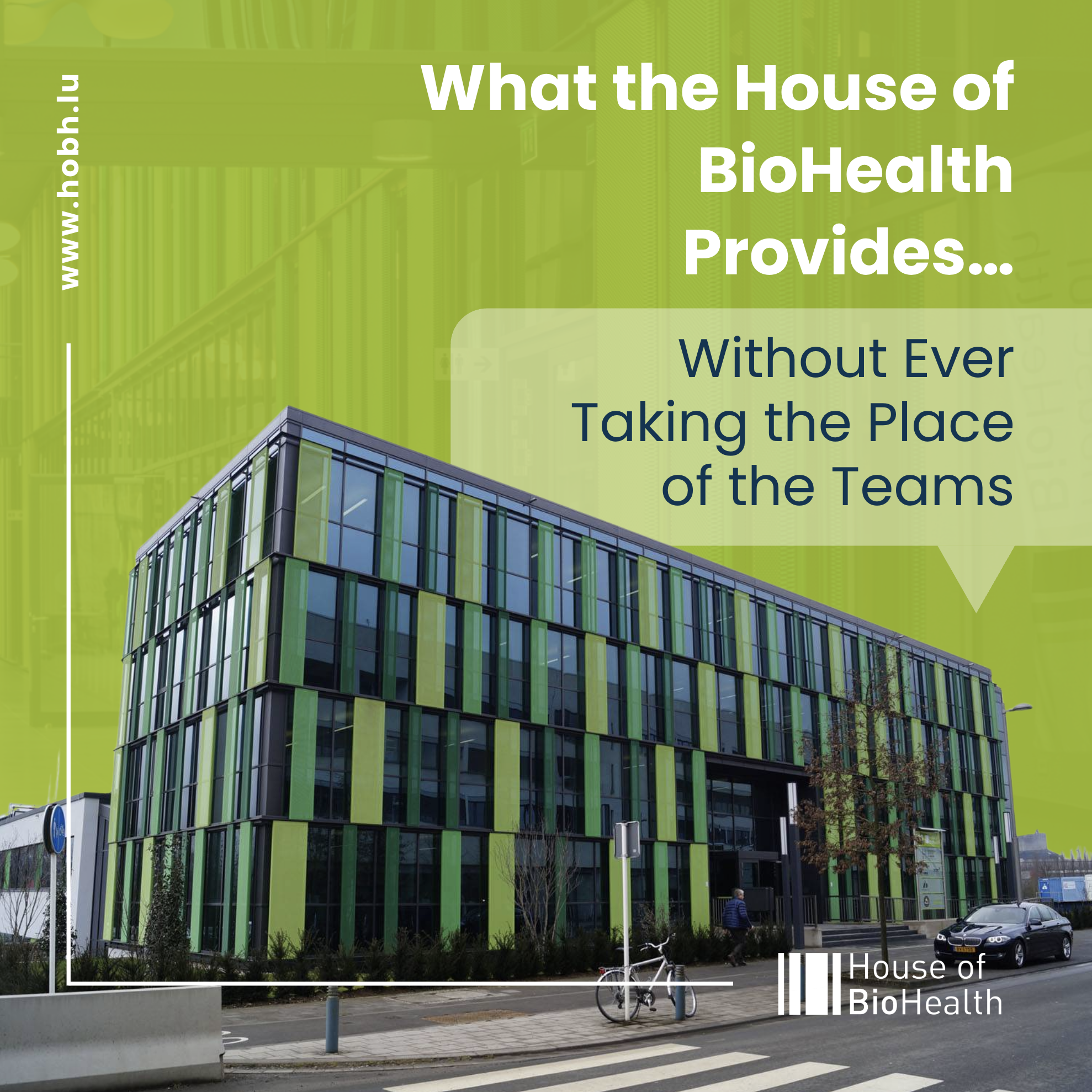
In the world of healthcare innovation, support often gives rise to mixed feelings. On the one hand, project leaders recognise the growing complexity of their environment: regulatory requirements, organisational structuring and institutional credibility. On the other hand, they fear that overly involved support could encroach on their autonomy, their vision or even their governance.
This tension is understandable. It explains why the question today is no longer “Should we seek support?” but rather “How can we receive support without losing control of our project?”
Supporting Without Directing: A Demanding Approach
Supporting a healthcare project does not mean mapping out its path on behalf of the teams behind it. On the contrary, it requires adopting a more subtle and sometimes less visible position: providing a framework, acting as a point of support and facilitating progress.
At the House of BioHealth, this approach is a founding principle. The HoBH is neither an accelerator that imposes its own pace nor a decision-making body. It does not define strategies, manage teams or take the place of founders, researchers or executives.
Its role lies elsewhere: creating the conditions that enable teams to make better, more confident and more sustainable decisions.
Providing a Clear Framework in a Complex Environment
Healthcare innovation is characterised by a particularly dense set of constraints. Even the most promising projects can be weakened by a lack of structure: an unsuitable working environment, isolation, difficulty positioning themselves within the ecosystem or challenges engaging with external partners.
In this context, having a clear framework becomes a source of stability.
This is precisely where the House of BioHealth plays its part: it provides a clear structure, a recognised professional environment and a working framework aligned with the sector’s requirements.
This framework does not dictate decisions. It makes them possible.
Preserving Team Autonomy
One of the main risks associated with certain support programmes is the standardisation of project journeys. Yet in healthcare, no two projects are alike. Their timelines differ, as do their challenges.
The HoBH rejects any one-size-fits-all approach. Each project retains its own pace, priorities and governance. The support provided is based on adaptability rather than the replication of a predefined model.
This approach allows teams to remain fully in control of their projects while benefiting from a structured and secure environment.
The Discreet Role of an Outside Perspective
An outside perspective is only valuable if it respects the project’s identity. At the House of BioHealth, the aim is not to assess or judge, but to shed light.
Identifying blind spots, asking structuring questions and anticipating key transitions: this process helps teams step back and gain perspective on their own trajectory. It improves the quality of decision-making without ever taking control away from them.
It is often through this discreet approach that support proves most useful.
Support That Evolves Alongside the Project
The needs of a healthcare project are not fixed. They evolve with its maturity, its team and its ambitions. Support must be able to follow this development without becoming rigid.
The House of BioHealth provides this flexibility. It does not confine projects within a fixed framework but allows their environment to evolve at the same pace as their development.
This continuity is essential to avoid sudden disruptions, which are often costly in terms of both energy and credibility.
Finding the Right Balance
What the House of BioHealth offers is neither complete management nor simple accommodation. It is a balance: between structure and freedom, support and autonomy, a shared framework and the unique nature of each project.
Because in healthcare innovation, it is the teams that make the difference.
The role of a place like the HoBH is to enable them to realise their full potential—without ever taking their place.